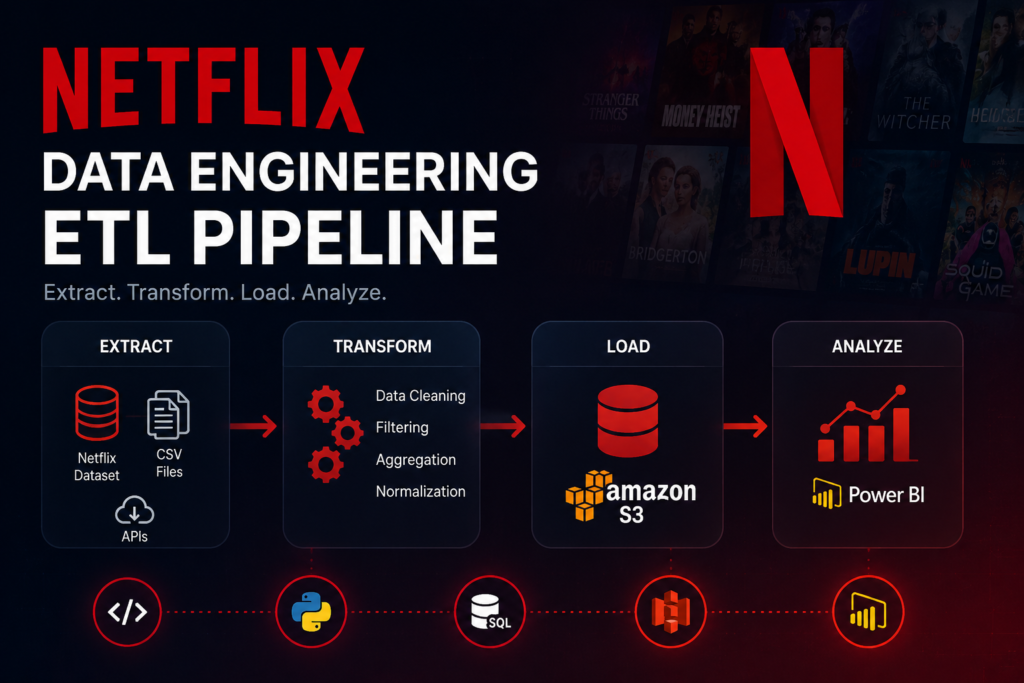
Data Engineering

image

Netflix Data Engineering ETL Pipeline

This project is a real-world data engineering ETL pipeline built using a Kaggle Netflix dataset. The goal is to demonstrate how raw, messy data can be validated, cleaned, verified, and prepared for downstream analytics or data warehouse loading. The pipeline follows professional data engineering practices such as raw vs cleaned data separation, schema and quality validation, modular ETL design, and early failure on bad data. 🎯 What This Project Does Outputs (Saved Plots)      Run

Netflix Data Engineering ETL Pipeline Read More »

fake news detector (2)

Nepali Fake News Detector 🇳🇵

An AI-powered web application that detects whether a news article is REAL or FAKE, designed for Nepali and English content. 🌐 Live Demo 👉 https://demo.purwanews.com/ 🚀 Features 🧠 How it works User Input → API → ML Model → Prediction 📊 Dataset Used The dataset used in this project is sourced from Kaggle: 👉 https://www.kaggle.com/ashoknepal/datasets 🧠 Dataset Description ⚙️ Data Processing To prepare the dataset for training: 📌 Final Dataset Format news_contextlabelNews text…0News text…1 ⚠️ Note 🛠 Tech Stack 📂 Project Structure fake-news-api/ │ ├── api.py ├── passenger_wsgi.py ├── train_model.py ├── model.pkl ├── vectorizer.pkl 📊 Model Accuracy ⚠️ Disclaimer This system provides AI-based predictions and may not always be 100% accurate. 👨‍💻 Author Santosh Poudel

Nepali Fake News Detector 🇳🇵 Read More »

image2

NLP for Fraud Detection in Social Media

🎯 Research Overview This research investigates the application of Natural Language Processing (NLP) and Text Mining techniques for detecting fraudulent activities on social media platforms. The study focuses on three specific fraud types: cyberbullying, fake reviews, and misinformation. Author: Santosh PoudelDegree: MSc Information TechnologyInstitution: University of the West of ScotlandCompletion Date: December 2023 📊 Abstract This research addresses the significant challenges in identifying fraudulent activities in social media environments. The project explores the effectiveness of NLP techniques, including Naive Bayes classification, TF-IDF, and N-gram modelling, across three distinct datasets. The study demonstrates adaptive fraud detection capabilities with accuracy rates up to 86% on fake review detection. 🚀 Key Features 📈 Key Results DatasetBest ModelAccuracyPrecisionRecallF1-ScoreCyberbullyingUnigram Features73%71.8%81.4%75.8%Fake ReviewsCombined Features86%82%93%87%MisinformationCombined Features81%78%91%84% 🛠️ Technical Implementation Algorithms & Techniques Tools & Technologies

NLP for Fraud Detection in Social Media Read More »